Disclosure: This post contains affiliate links. If you make a purchase through one of these links, we may earn a small commission at no additional cost to you. As an Amazon Associate, we earn from qualifying purchases.
Most home offices don’t fail because the desk is too small or the room is too dark. They fail because everything in them is homeless. Chargers live wherever the cable happens to reach. Paperwork forms a pile that grows until it becomes a filing system by accident. Pens migrate to every surface except the cup that’s supposed to hold them. None of that is a character flaw — it’s just a space with no rules. Give it a few, and the same desk starts to feel like somewhere you actually want to sit down and work. Here are six upgrades that go deeper than “buy a bin,” organized so you can tackle one a weekend if that’s all the time you have.
1. Give Every Cable a Track, Not a Tangle
The fastest way to make a desk look chaotic — even a clean one — is a nest of cords hanging underneath it. It’s also one of the easiest fixes, because the problem isn’t the cables themselves, it’s that they have nowhere defined to sit. A cable tray mounted under the desktop gives every charger, hub, and power strip a single shelf of its own, off the floor and out of sight, instead of draped across your knees or tangled around chair wheels. The upgrade here isn’t just cosmetic: a dedicated tray also means you can actually find the right cable when you need to swap a charger or unplug a hub, instead of tracing three identical black cords back to their source.
Cinati Under-Desk Cable Management Tray

Currently an Amazon’s Choice pick with a 4.7-star average, and the install really is as simple as it sounds.
- No-drill install — clamps straight onto the underside of most desks, no tools beyond the included clamp
As an Amazon Associate we earn from qualifying purchases. Price and availability may change.
2. Sort Papers Into Three Zones, Not One Pile
A single inbox tray works for about a week before it turns into an archaeology project. Instead, split paper into three honest categories: Active (something you need to act on this week), Reference (things you might need to look up later, like manuals or tax documents), and Archive (records you’re required to keep but will probably never open again). Active stays on the desk in a slim tray you’re forced to look at. Reference goes into a labeled folder or small file box within arm’s reach. Archive gets boxed and moved out of the office entirely — a closet shelf or under-bed bin is fine, because by definition you don’t need daily access to it. The point isn’t a perfect filing system; it’s making sure “I’ll deal with it later” has an actual destination instead of becoming a permanent desk feature.
3. Move Small Supplies Off the Desktop and Onto the Wall
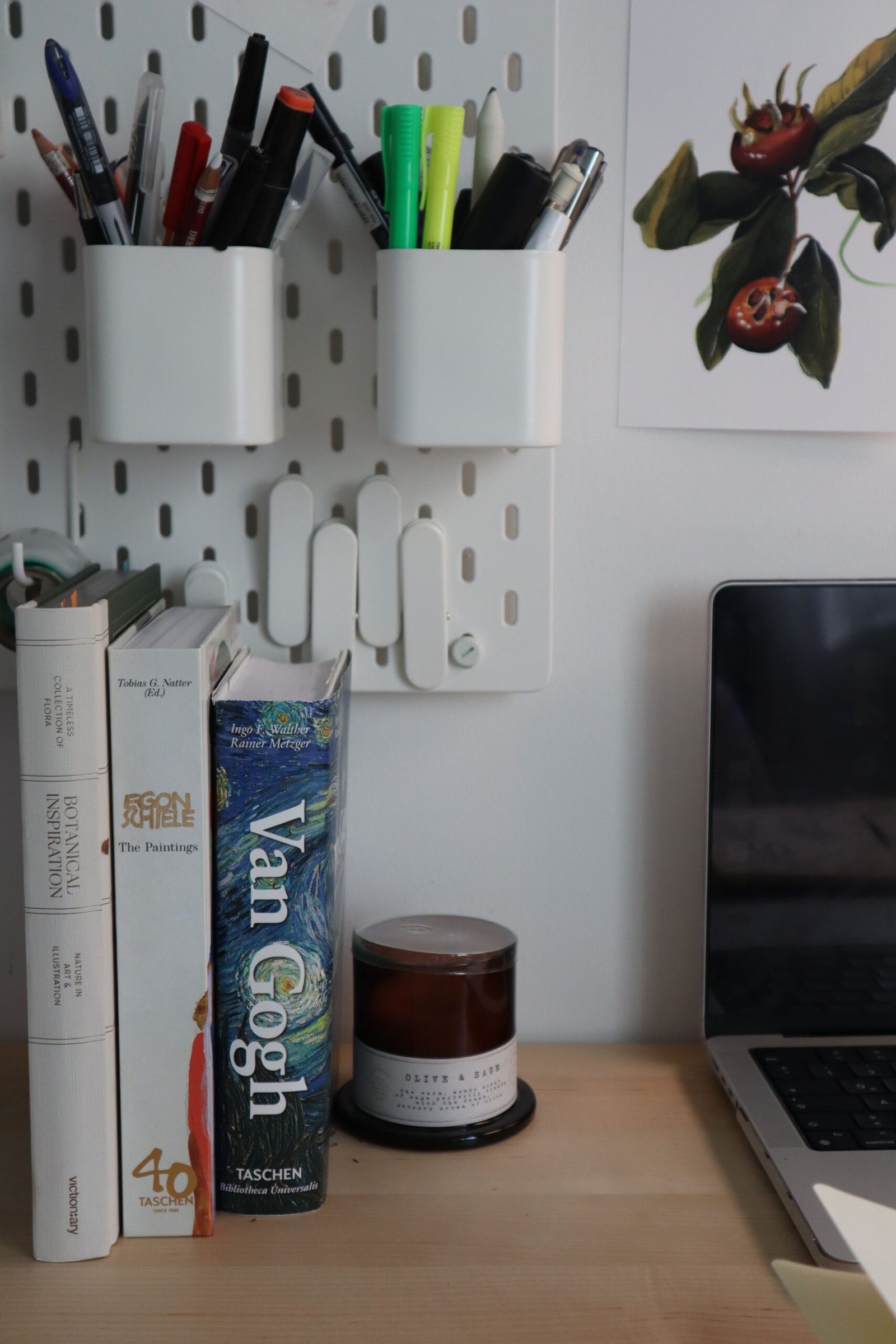
Desktop real estate is the most expensive space in the room — it’s the surface you actually use — so it shouldn’t be spent storing pens, sticky notes, and the stapler you touch twice a week. A pegboard, magnetic strip, or a simple set of wall-mounted cups moves all of that vertical, freeing up the flat surface for the laptop, notebook, and whatever you’re actually working on right now. It also makes tidying faster: putting something “back” means one motion toward the wall instead of finding a specific drawer.
4. Create a Landing Zone Outside the Office
Keys, mail, your badge, the package you keep forgetting to return — none of that belongs on your desk, but it ends up there anyway because there’s no better option on the way in. Set up a small tray, hook, or shallow basket near the entrance to the room (or the house) specifically for transitional items. The rule is simple: if it’s not office work and not a permanent fixture, it goes in the landing zone, not on the desk. This one change quietly prevents a huge share of the clutter that accumulates on a workspace by the end of the week.
5. Claim the Space Above Eye Level
Most home offices stop storing things once they run out of desk and floor space, but the wall above eye level is almost always empty. That’s prime real estate for anything you need occasionally but not daily: reference binders, spare cables, extra office supplies, backup hard drives. A single floating shelf near the ceiling line keeps rarely-used items accessible without letting them compete for space with the things you reach for every day. It also has a side benefit: a shelf up high draws the eye upward and makes a small office feel less cramped, not more.
6. Replace the Big Cleanup With a 5-Minute Reset
The reason home offices slide back into chaos even after a great organizing weekend is that there’s no maintenance step — just one big cleanup, followed by months of drift, followed by another big cleanup. A short daily reset breaks that cycle: before you close your laptop for the day, spend five minutes putting loose papers into their zone, returning supplies to the wall, and clearing anything that landed on the desk that doesn’t belong there. Five minutes a day is a very different commitment than a Saturday afternoon, and it’s the difference between a system that holds and one you have to rebuild every few months.
Have a home office fix that’s made a bigger difference than you expected? Drop it in the comments below — we’re always looking for the next upgrade worth testing.